The control plane for GPU clouds
Charge More Per GPU
Turn your GPU fleet into a Token Factory











Latest news
All blog posts →

Partners
Saturn Cloud runs on the infrastructure you already have
You picked your GPUs, your Kubernetes, and your cloud. Saturn Cloud installs on top of all of it and turns it into token-metered AI services.
AI infrastructure
Deploy onto the Kubernetes and bare metal platforms your team already runs.
Mirantis · Rafay · Spectro Cloud · OpenNebula · SUSE
See AI infrastructure partners →Hyperscalers
Install into your own cloud account, on capacity you already hold.
AWS · Azure · Google Cloud · Oracle
See hyperscaler partners →Neoclouds
White-label the platform on GPU-native infrastructure.
Nebius · Crusoe
See neocloud partners →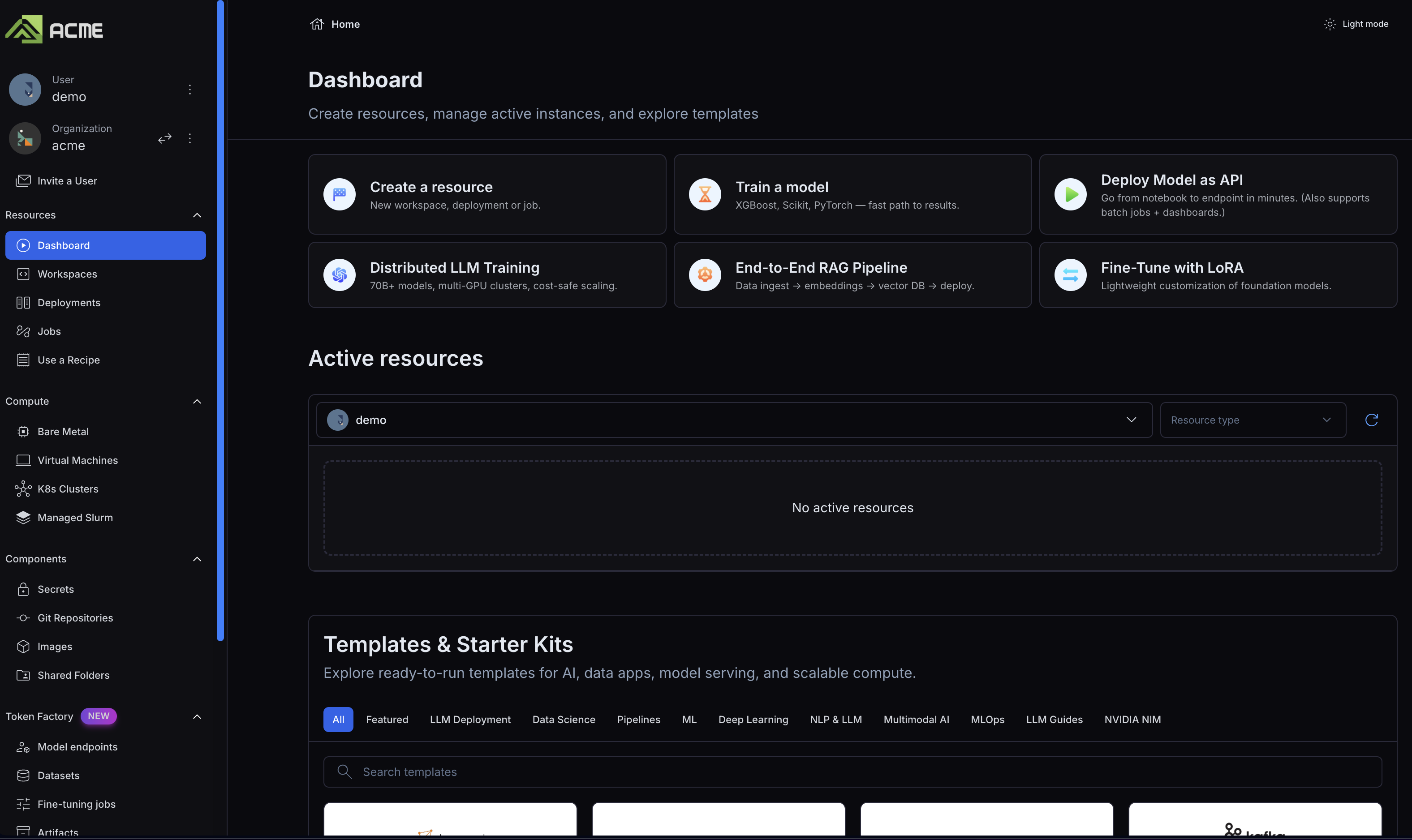
Multi-tenant isolation
Hardware-boundary isolation for every customer
Each of your customers gets their own Kubernetes or Slurm cluster, provisioned through the console via your BMaaS partner. No shared scheduler, no shared etcd, no shared admission webhooks between customers.
- Per-tenant Kubernetes and Slurm clusters, single-tenant by default
- Per-tenant InfiniBand P_Keys coordinated with your networking vendor at provisioning time
- Per-tenant storage namespaces on VAST Data, Weka, or your existing filesystem
- Per-tenant SSO federation, each customer brings their own IdP
Tenant A
K8s Cluster
8×H100
P_Key 0x1
IB fabric
Storage NS
/tenant-a
Tenant B
K8s Cluster
4×H200
P_Key 0x2
IB fabric
Storage NS
/tenant-b
Zero shared resources · No shared scheduler · No shared etcd
Day-2 support
Your 24/7 GPU operations team, included
When something breaks at 3am, your team isn't the one getting paged. Saturn Cloud owns the incident response and drives escalations into your BMaaS, networking, and storage vendors on your behalf.
- 24/7 on-call rotation staffed by GPU and Kubernetes specialists
- Single point of accountability, Saturn drives escalation into your BMaaS, networking, and storage partners
- Workload-aware rolling upgrades for kernel, driver, and Kubernetes versions, without breaking active customer workloads
- GPU-specific monitoring: Xid error detection, NVML metrics, automatic node cordoning
- Custom SLOs defined in your contract, response and resolution targets negotiated per deployment
- Postmortems and status communication so your customers see the operator who's accountable, not the vendor underneath
Incident timeline
INC-2418
Xid 79 detected on node gpu-h100-04
NVML monitor
Node cordoned, workload migrated
Saturn control plane · automated
Saturn on-call paged
Customer NOC unaware
RMA escalated to BMaaS partner
Single ticket, Saturn drives
Resolved, postmortem sent
Zero customer-visible downtime
Saturn owns the incident, your team owns the relationship
Metering & billing
Hourly usage records, contract terms applied automatically
Every GPU-hour is tagged with the owning user, project, and tenant at creation time. Contract terms, including committed use, on-demand, and reserved, are applied automatically. Invoicing data is available through the API and as a Snowflake view for your finance team.
- Per-GPU-hour metering tagged by user, project, and tenant
- Per-token metering for inference, billed through the same pipeline
- Chargeback reporting so your customers can allocate costs to internal teams
- Contract term automation for committed, on-demand, and reserved pricing
- API and Snowflake export for BI and finance tooling
Monthly GPU usage by team
May 2026
Orchestration
From bare metal to Token Factory, orchestrated as one stack
Saturn drives every layer of the stack from a single control plane. Your customers move from a bare-metal request to a running inference endpoint without leaving the console, and without your team writing the glue between layers.
Token factory, standard inference endpoints
Interactive in workspaces or as managed jobs
JupyterLab, VS Code, SSH, persistent storage
Per-tenant clusters, HPC scheduling
Per-tenant clusters via your BMaaS partner
Provisioned through Mirantis, Red Hat, Rafay, Spectro Cloud, Open Nebula, Suse, Nutanix and others
Your hardware, your capacity contracts, your brand.
GPU infrastructure
GPUs your customers can provision through the console
Saturn Cloud supports the full NVIDIA GPU stack. Your customers choose the hardware, configure the cluster size, and launch workloads through the console.
1 to 8 GPUs per workload, from $2.95/hr. Compare GPU specs and pricing →
FAQ
Common questions from GPU cloud operators
Saturn Cloud integrates with Mirantis (k0rdent), Red Hat (OpenShift / Assisted Installer), Rafay, and others. The console calls your BMaaS partner's API to provision bare metal on demand. You keep your existing BMaaS relationship, and Saturn Cloud is the customer-facing surface on top of it.
Isolation happens at the hardware boundary, not inside a shared control plane. Each customer gets their own Kubernetes or Slurm cluster, their own InfiniBand P_Key, and their own storage namespace. There is no shared scheduler, etcd, or admission webhook between customers.
Yes. Your customers log into your brand, on your domain. Saturn Cloud supports custom logos, color palettes, and domain configuration without code changes.
Saturn Cloud can be stood up on your infrastructure in 15–30 minutes via Terraform and operator-based install. The conversation with our team covers BMaaS integration, networking and storage vendors, billing format requirements, and the customer experience on day one.
A productized inference business: your customers hit a standard inference endpoint, you serve the model on your GPUs, and billing is per-token. Saturn Cloud offers a catalog of quantized open-weights models deployed via vLLM with per-customer endpoints. Autoscaling, model lifecycle management, and per-token metering are included. Learn more →
No. Saturn Cloud sits above bare metal, not next to it. We integrate with your BMaaS vendor (Mirantis, Red Hat, Rafay) and your networking and storage vendors (Netris, VAST Data, Weka). You keep your hardware, capacity contracts, and vendor relationships.
Turn your GPU fleet into a Token Factory
Stop provisioning by hand and start shipping a productized AI platform. Saturn Cloud deploys on your infrastructure in days, not quarters.